HomeInsightsCompany Social Media Pages
Before you hand over your company's pages in Libya: what to settle first
When you hand your company's pages to a freelancer or an agency, the conversation tends to be about posts: how many a month, and at what price. Less is said about the questions that cause trouble later, such as whose account the pages sit in, who can add or remove people, and what happens on the day the contract ends, or when a fake page using your name starts messaging your customers. This guide covers what to settle before you sign, and how to protect your pages from hacking and impersonation.
Admin roles and agency access on Facebook and Instagram
Your pages, ad accounts, and source files belong to your company, and an agency should only get access you can withdraw. Our guide to choosing a marketing agency in Libya sets out the basics; on Facebook and Instagram, they come down to a handful of settings. The tool and setting names in this guide are the ones Meta uses as of November 2026. Its menus change, so check its help pages before you follow the steps.
A business portfolio your company owns. Keep your Facebook page, your Instagram account, and any ad account in a business portfolio that belongs to your company. You manage the portfolio in Meta Business Suite (formerly Business Manager). If the agency or a freelancer created the portfolio, they control it.
Two admins from your own staff. Give at least two people who work for you the highest level of access, the level that lets someone add and remove others. If one of them leaves or loses their phone, the other can still get in.
The agency as a partner, with no shared password. An agency that has its own business portfolio can be added as a partner, and a freelancer to your list of people, each limited to what the work needs. Nobody should sign in with someone else's password: you cannot take a shared password back from just one person, and there is no way to tell who posted what.
Separate access for each brand. If your company runs more than one brand, Meta Business Suite lets you put each brand's pages and accounts in a business asset group and share that group only with the people who work on the brand.
Boosted posts. If anyone boosts posts for you, the ad account belongs in your business portfolio too. Paid media buying is not on our published service list. Our page on hiring a marketing agency in Tripoli, Libya sets out what our campaign work covers.
When the contract ends, or the only admin leaves
Write the handover into the contract and have it finished before the last payment: the outgoing agency or freelancer confirms that two of your staff still hold the highest level of access, removes their own access or the partner link, and delivers the files you agreed on. Then open the list of people and partners yourself, and check that nobody from the old arrangement is still on it. If you ever gave anyone a password, change it the same day.
The harder case is a page whose only admin is a single person on their personal account: a former employee, say, or a freelancer you no longer work with. Changing the admin then depends on that person. Ask them to add two of your staff with the highest level of access, and to remove themselves only after that. If you can no longer reach them, all you can do is ask Meta support for help, and you will have no say in how long it takes or what Meta decides. Sort it out while you are still on good terms.
Protect your pages from hacking and impersonation
Two risks sit outside any contract: someone breaking into an admin's account, and someone opening a page that pretends to be yours. You cannot rule either out, but you can make both harder to pull off.
Two-factor authentication on every account. Everyone with access to your pages, on your staff or the agency's, should turn it on for their own Facebook and Instagram accounts. Meta Business Suite can also require it for everyone in your business portfolio rather than for admins only, so switch that on. Keep each admin's phone number and email address up to date, because that is how they get back into a locked account.
A regular check of who has access. Go through the list of people and partners at a fixed time, such as the start of each quarter, and on the day anyone leaves. Remove anyone who no longer needs access.
Your official accounts, listed on your website. Link every official page and account from your website, and link back to the website from each of them. A customer who is unsure can then check which page is really yours.
Reporting a page that imitates yours. Start from the fake page itself. On Facebook, open the page's options menu and choose Report Page; on Instagram, report the account from its profile and pick the option saying it is pretending to be someone else. Keep the link and a few screenshots. What happens to the report is Meta's decision, so do not wait for it: if the fake page is asking your customers for money or personal details, tell them on your official pages which accounts are yours.
Agree the scope and who answers messages
Page management can mean posting whatever you send over, or planning, producing, and reporting on everything that appears. Our page on social media management in Libya sets out the five parts of the work as we do it; whoever you hire, ask for their version of that list in writing.
Then settle who replies to comments and private messages. Those replies speak for your company, and comments and messages are where customers ask about prices, follow up on orders, and complain. Agree whether the agency or freelancer answers them or passes them to you, which questions always come back to your staff, and how long a customer should wait for a reply.
A freelancer or an agency?
Either can do the work well. A capable freelancer may be enough for a small business with one page, and an agency brings more people. In practice, the difference shows in continuity: what happens to your pages when the person running them is away or leaves.
A freelancer is one person, so ask who posts and replies when they are ill, traveling, or busy with a bigger client. An agency has other staff to cover, but its people change too, so check that your pages do not depend on one employee's personal account. The access rules above apply to both, and they matter most when one person runs everything.
Several brands under one company
A group that runs brands in different markets needs each brand to talk to its own audience, while people can still see that the brands belong together. Before the first monthly plan, agree with whoever manages them how each brand should sound and what the brands will share.
Biout Aleaz is one example: a holding company with brands in very different markets, from sanitaryware and plaster to a resort. For three of its four brands (building-materials import, plaster, and the Manazel Aleaz resort), we planned the content month by month, designed the posts, and reported on each month. The result was hundreds of posts that keep each brand recognizable on its own and as part of one group.
Questions to ask before you sign
Put these questions about your pages to every freelancer or agency you are considering, and compare the answers side by side. For subcontracting, reports, and source files, use the checklist in our guide to choosing a marketing agency in Libya.
Who answers messages, and how fast? Ask too which questions come straight back to your staff.
How do you get access, and how is it removed? The answer you want: through your company's business portfolio, as a partner or a named person, removed on the last day.
Will you write the Arabic or translate it? If you publish in both languages, the Arabic should be written natively rather than translated from the English, and carry the same message. That was the standard for the bilingual social media systems we produced for the United Nations Support Mission in Libya.
How Pattrix runs social channels
Pattrix is a strategic communications and PR agency in Tripoli, Libya, so we run social channels as part of one communication system rather than as a separate stream of posts. We make the content in-house: reels, photography, design, and copy. Our page on content and video production covers the filming and photography. For Tripoli Optics, we produced a running series of in-store reels, shot around the product with editorial pacing.
Put the questions in this guide to us as well.
Related reading
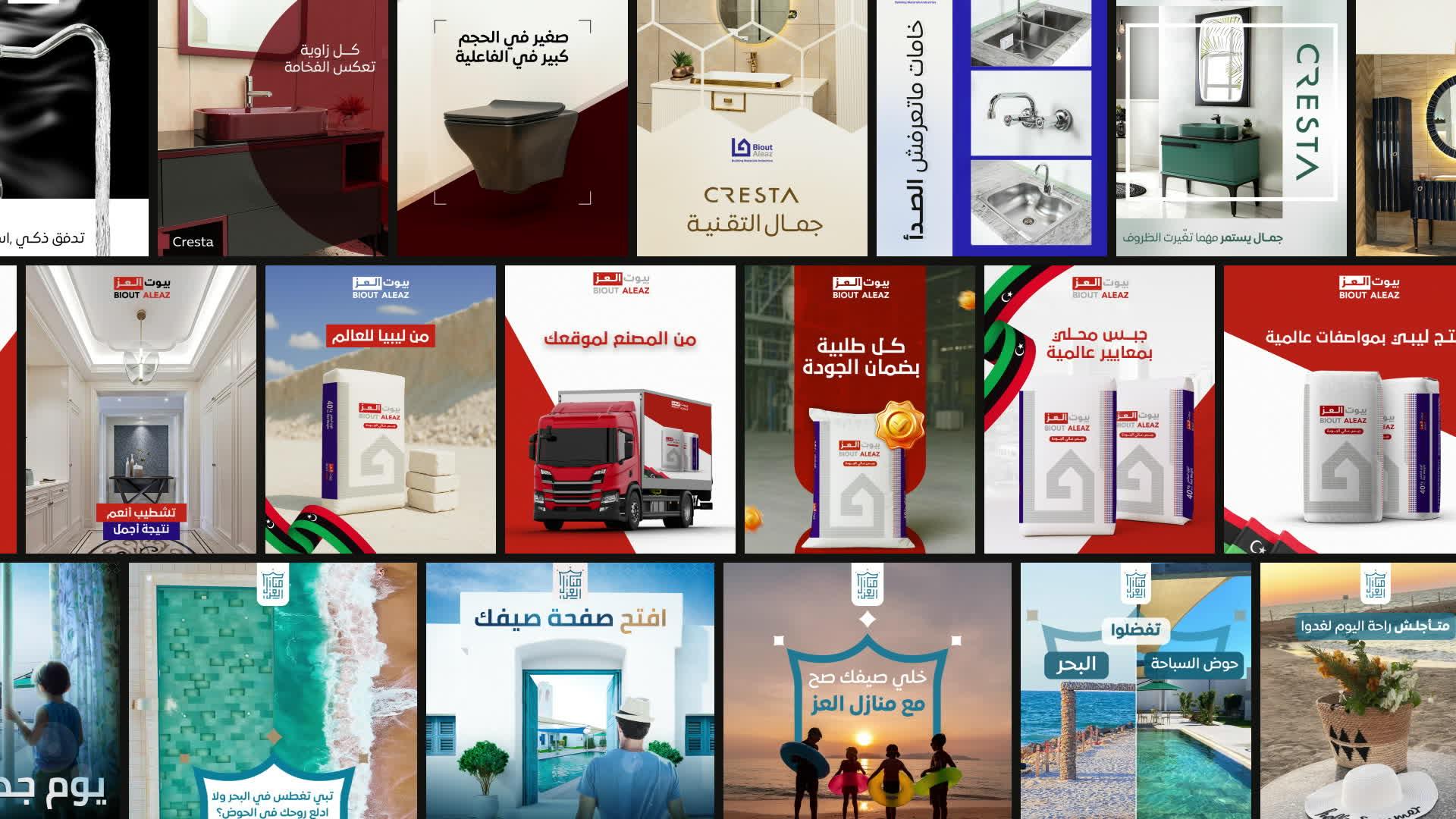
Biout Aleaz — Social Media for Four Brands
Social media content for the four brands of Biout Aleaz Holding in Libya: building-materials import, plaster, the Manazel Aleaz resort and Qimmat Aleaz.
Read the case study

Tripoli Optics — Reels & In-Store Content
Reels, product photography, and in-store content production for an optics retailer in Tripoli.
Read the case study
- How to choose a PR agency in Libya
- How to choose a marketing agency in Libya
- What strategic communications means for Libyan institutions
- PR vs marketing: what businesses in Libya actually need
- Why campaigns in Libya fail without analysis first
- Entering the Libyan market: a communications plan for your launch
- How to commission an ad video in Tripoli, Libya
- Ramadan campaigns in Libya: what to prepare and when
- How to brief the team covering your event in Libya
Planning to hand over your pages?
Tell us which pages you run and who you need to reach, and we'll start with a working session.