
HomeInsightsStrategic Communications
What strategic communications means for Libyan institutions
Few institutions in Libya lack communication activity. Ministries publish statements, missions post updates, organizations run pages. What is often missing is the system behind the activity: a reason for each statement, an order in which messages appear, and the editorial control that keeps them consistent. That system is what strategic communications means. For institutions whose public statements have consequences, it decides whether they are understood or tuned out as noise.
Publicity reacts. Strategy decides.
Ad-hoc publicity is easy to recognize: a statement when something happens, a post when there is a photo, a burst of activity around an event, then silence. Each item may be well produced, but nothing connects them. The audience is left to piece the institution's story together, and most audiences will not do that work.
Strategic communications reverses the order. Before any material is produced, it settles who the institution is addressing, what it needs them to hear, and in which sequence. Once those answers exist, every statement, post, and appearance repeats the same message instead of improvising a new one.
Message architecture comes first
One central message. A single sentence the institution needs its audience to remember. If it cannot be stated plainly, publishing more will not make up for it.
Derived messages. Every variant for a channel or audience is derived from the central message. Nothing is written from scratch alongside it, so what leadership says, what the pages publish, and what appears in coverage stay aligned.
Language written to be quoted. Institutional language gets quoted, screenshotted, and challenged. Write every public sentence as if it will be read back to the institution, because it often is.
Channel order in Libya matters more than channel count
Libyan audiences divide their attention between traditional media and social platforms, and no institution can be equally strong everywhere. So the practical question is the order in which a message travels: where it is first stated as the official record, where it is explained, and where it is repeated.
Getting the sequence right shows that the institution controls its own message. When an announcement appears on the official channel before it circulates elsewhere, the institution owns the record. When audiences hear of a decision from commentators before they hear it from the institution, correcting the story costs more effort than the original message would have.
Consistency under scrutiny
Institutional statements are held to a stricter standard than commercial campaigns: precise detail, official language, and the same meaning in Arabic and English. When the two versions of a statement differ, the public reads the gap as a difference in intent.
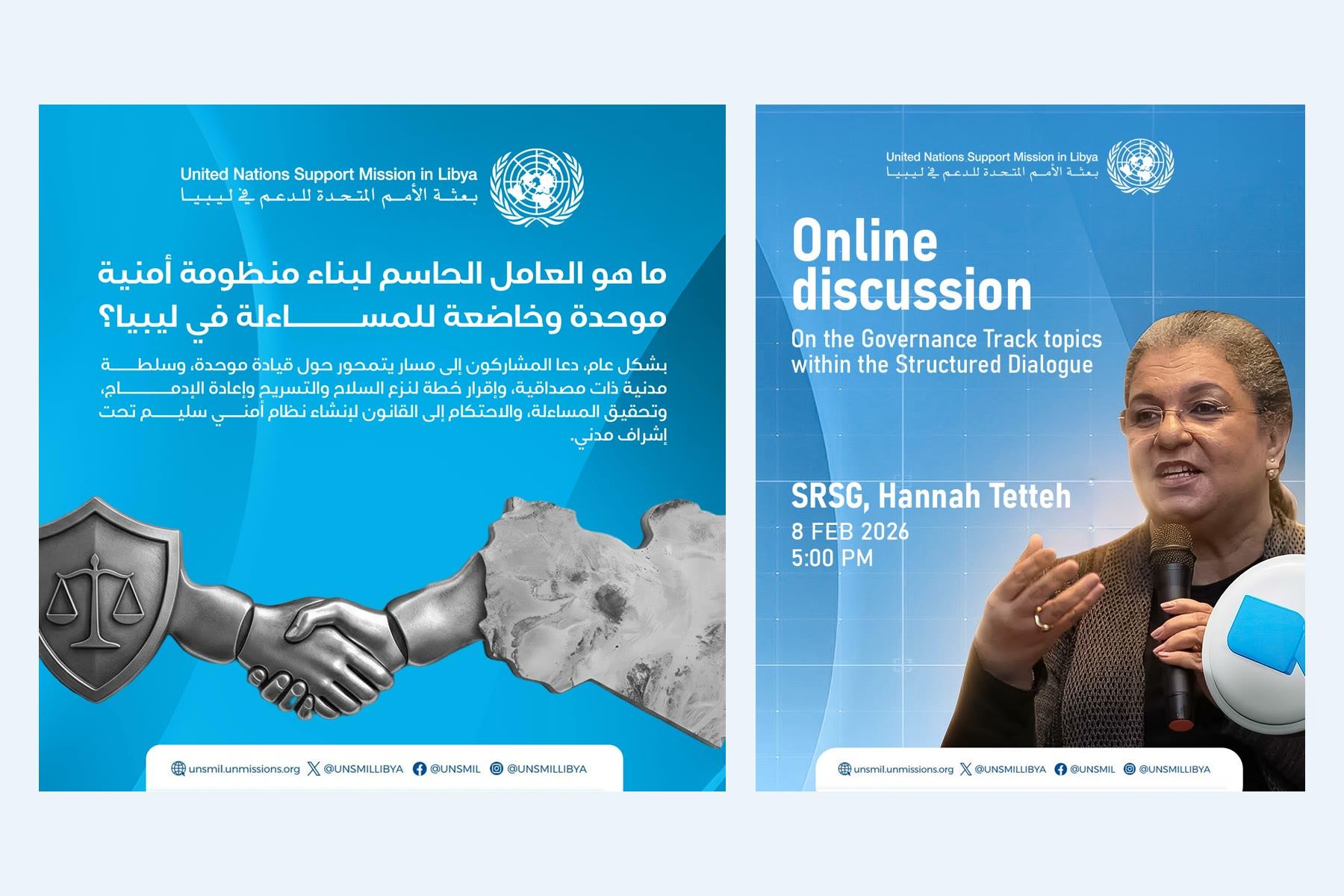
That is why Arabic material should be written in Arabic from the start, with the message held constant across both languages. Our work with the United Nations Support Mission in Libya was built on that requirement: bilingual institutional media for governance dialogues, official announcements, and public discussion formats, produced in one consistent visual language.
What a strategic communication system includes
Positioning. The place the institution holds in its audience's mind, and what sets it apart, defined before any campaign.
Message architecture. The central message and its derived variants for each channel and audience, documented so anyone speaking for the institution draws from the same source.
Audience and channel planning. Who is being addressed, which channels they follow in Libya, and the order in which those channels carry each announcement.
A publishing rhythm. A steady cadence the institution can sustain, instead of bursts around events followed by silence. A regular schedule also tells the audience the institution is stable.
Realistic measurement. Indicators agreed before work begins: whether the message appears in coverage, how consistently it holds across channels, and how stable the institutional narrative stays over time.
Where to begin
You do not need a large department to start, only a decision to stop treating communication as a series of reactions. A useful first exercise: write the one sentence your institution needs its public to remember this year, then audit the last month of published material against it. Count how many of those items carry that sentence in any form. The gap between that count and the total is the distance between activity and strategy.
Pattrix is a strategic communications and PR agency based in Tripoli, Libya, working with institutions, brands, and international organizations in Libya and abroad. If your institution is missing the system described here, our page on strategic communications in Libya explains how we build it.
Related reading
Start with the one sentence.
Tell us what your institution needs its audience to understand, and we'll plan the order in which that message travels.